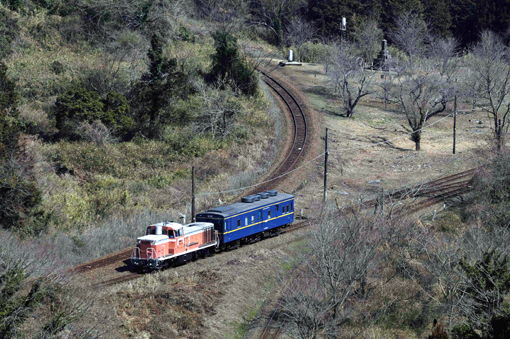
A strange train on the Okoba switchback.
The DE10 is currently the only diesel road switcher in use by the various railways in Japan. The DE10 was developed by JNR in 1966 as a successor to the short-lived DD20. The DD20, initially developed as part of JNR’s modernization away from steam, was unsuited to branch-line use because of its high axle-weight, and unsuited to switching operations because of excessive slippage under load. The DE10 was developed to address these issues while increasing the overall horsepower. The weight was increased to 65t to improve traction; however doing so far exceeded the axle load of most switching yards and branch lines. To compensate, one bogie was extended to three axles, reducing the axle load while solving the traction problem, and giving the DE10 a unique profile.
Although the locomotive appears a C0-B0 class, the axles in the three-axle bogie are independently articulated, allowing the long bogie to negotiate the tight curves often encountered in switching yards. Thus, properly speaking, the DE10 is classified as A0A0A0-B0. It has a maximum operating speed of 85 km/h (53 mph), and produces a maximum output of 1,000kW (1350 HP).
Unlike many center-cab designs, the DE10 console faces sideways to the locomotive, so that during shunting operations, the engineer can accomplish reverse moves by simply turning his head, rather than getting up and moving to a different console.
Like most Japanese diesels, the DE10 is not diesel-electric. Rather, the V-12 diesel engine is connected to all five axles via a two-stage hydraulic transmission. This continuously variable transmission allows the DE10 to operate with a maximum speed of 45km/h in low “gear” and 85km/h in high.
(Sources: Wikipedia, JR’s Rolling Stock Guide.)
