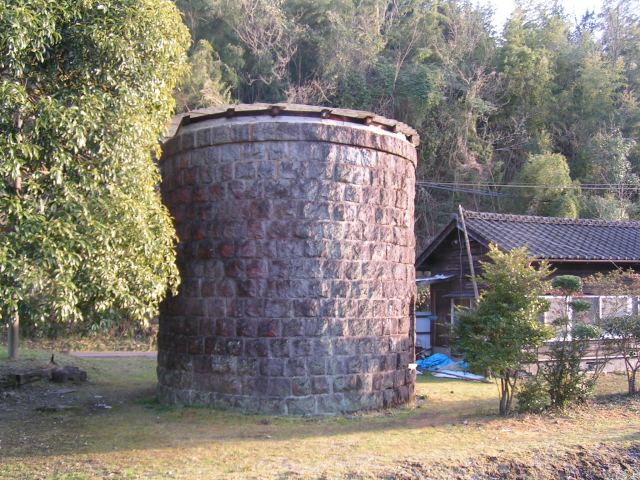
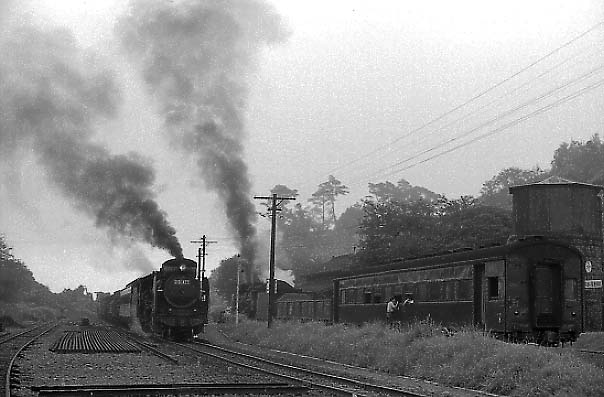
For years railfans have posted photos of its stone base, still intact today.
 |
| Source |
 |
| Source |
|
| Source |
|
| Source |


Okoba Station (大畑駅 Okoba Eki) is a railway station on the JR Kyushu Hisatsu Line situated 5 kilometers (3 miles) south of Hitoyoshi, Kumamoto Prefecture. According to the Denshi Jisho — Online Japanese dictionary 大 means 'big or large', 畑 means 'farm, field, or garden', so the station name is most likely to mean 'large field'.
Okoba is the first stop from Hitoyoshi on the Mountain part of the Hisatsu Line, known for its long and numerous tunnels and steep gradients. Because of the gradients often two or three steam engines were required to pull heavy freight trains up (and down) the Yatake Mountain. Therefore all the stations had steam servicing facilities, which at Okoba consisted of a water tower and a service track (according to once source there used to be a locomotive shed).
Okoba is the only station in Japan to have both a full double switchback and a loop. This was necessary to overcome more than 50m (165 feet) elevation in a very limited space, so all the trains had to stop at Okoba.
The station has two stub-ended arrival-departure tracks plus a service track. It has a Meiji-era style wooden station building that is similar to Yatake and Masaki station buildings and that has been restored to its original look at the time the special historic Isaburo-Shinpei tourist train was launced. This is an unmanned station.
Many cherry and plum trees are planted around the station, and the place is widely attended during a plum blossom festival.
Track Configuration
 Please click for a full size version. One chain is 66 feet or 20,1 meters, so the station has the smallest radius of 860 feet or 260 m. According to available video footage there is a small tunnel on the upper portion of the loop not shown on this scheme.
History
The station was built in order to accomodate and service steam locomotives heavily used on the mountain section of Hisatsu Line between Hitoyoshi and Yoshimatsu. Passenger operations were limited as the nearest town was about 1 hour walk away. The line itself was built for strategical reasons, as it allowed the circulation of trains between Kagoshima and Kumamoto prefectures without threats of coastal attack.
Because the track is continuously rising up the slope all the way from Hitoyoshi, the heavy steam engines used (mostly Class D51) required refilling of water and coal, while the engine drivers used a specially constructed fountain to wash away soot. Generally, the station saw heavy daily passenger and freight traffic.
Because of the complex track configuration the construction took a considerable time, and the station was opened on December 26, 1909. During the construction 13 workers died, and there is a monument commemorating their sacrifice near the start of the loop.
On October 17, 1927 an alternative coastal route - the Hisatsu Orange Line - was opened, which contributed to a slow decline of operations on the old Mountain line.
On November 1, 1986 electronic blocking was introduced, and the station was made unmanned.
On April 1, 1987 (JNR privatization) the station was transferred to the JR Kyushu.
When the Kyushu Shinkansen line opened, the passengers nearly stopped using Hitoyoshi-Yoshimatsu Mountain Line, however JR Kyushu launched a compaign for its preservation, which included restauration of the buildings and operating a special Isaburo-Shinpei train which underwent a retro-style interior refurbishment and travels twice a day. This train makes stops at touristic locations, which, together with constant tourist information announcements, makes the journey interesting, comfortable, and relaxing.
Sources

Track Plan

Far from ideal, of course, but nevertheless a nice start.
What I like about this plan:
What I don't like about this plan:
What to consider in the next version:


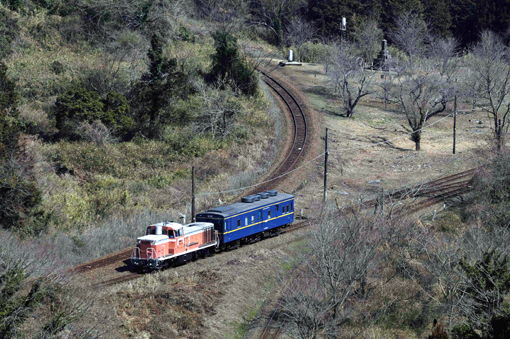
The DE10 is currently the only diesel road switcher in use by the various railways in Japan. The DE10 was developed by JNR in 1966 as a successor to the short-lived DD20. The DD20, initially developed as part of JNR’s modernization away from steam, was unsuited to branch-line use because of its high axle-weight, and unsuited to switching operations because of excessive slippage under load. The DE10 was developed to address these issues while increasing the overall horsepower. The weight was increased to 65t to improve traction; however doing so far exceeded the axle load of most switching yards and branch lines. To compensate, one bogie was extended to three axles, reducing the axle load while solving the traction problem, and giving the DE10 a unique profile.
Although the locomotive appears a C0-B0 class, the axles in the three-axle bogie are independently articulated, allowing the long bogie to negotiate the tight curves often encountered in switching yards. Thus, properly speaking, the DE10 is classified as A0A0A0-B0. It has a maximum operating speed of 85 km/h (53 mph), and produces a maximum output of 1,000kW (1350 HP).
Unlike many center-cab designs, the DE10 console faces sideways to the locomotive, so that during shunting operations, the engineer can accomplish reverse moves by simply turning his head, rather than getting up and moving to a different console.
Like most Japanese diesels, the DE10 is not diesel-electric. Rather, the V-12 diesel engine is connected to all five axles via a two-stage hydraulic transmission. This continuously variable transmission allows the DE10 to operate with a maximum speed of 45km/h in low “gear” and 85km/h in high.
(Sources: Wikipedia, JR’s Rolling Stock Guide.)