Hey World, it has been a while :)
I've kinda missed a new tv programme episode about my favorite Hisatsu Line, so here it is:
Friday, October 11, 2019

Monday, September 3, 2012

Monday, January 30, 2012
Tuesday, September 28, 2010
Water Tower in Okoba
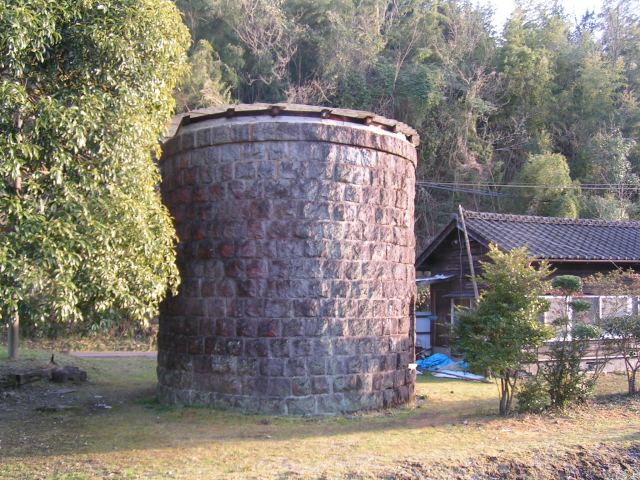
Water tower is one of the less noticeable features of the Okoba Station. It was once used for refilling the tenders of the hudge D51 locomotives that were often used in pairs in order to bring freight and passengers up the unbelievable 30 percent elevations around the station.
For years railfans have posted photos of its stone base, still intact today.
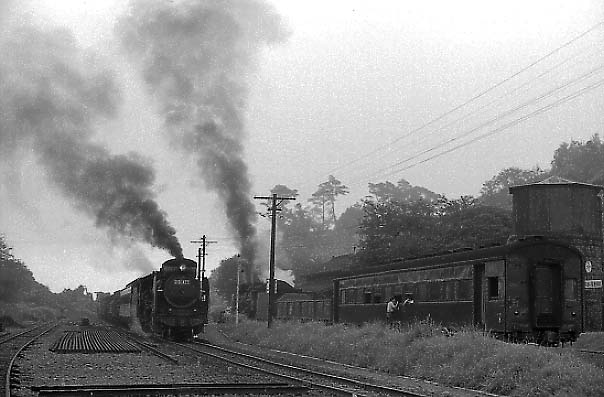
A recent search has quite unexpectedly turned up with a photo of the tower's water tank which is absent from all the other known photos available online.
This photo was taken in August 1970. The other photos in the set show quite an amazing number of mixed passenger-freight consists, often headed by a pair of D51-s, somewhat contrary to a viewpoint that freight trains were not widely operated on the line after the easier coastal route was opened.
For years railfans have posted photos of its stone base, still intact today.
 |
| Source |
 |
| Source |
Friday, September 24, 2010
Okoba Revisited. Now in T
It is the third year already, when autumn brings new inspiration for the construction of a Hisatsu-line inspired model railroad. During all the past months I've done quite a few things for my other project, i.e. the development of our community for those who model in HOe (1:87 on 9mm track). This has been successful, as I'm now slowly building my own module, and a much anticipated model of our very own TU2 Bo-Bo locomotive hit the shelves this summer.
A couple of days ago I've had an inspiration to find out what are the latest developments in T gauge, which we were happy to present at a local exhibition a couple of years ago (someone even posted an autotranslated newsitem on this somewhere on the net, that was fun).
48 hours later, and I'm still online, as it seems. New models, new tracks, new everything!
I was of course glad to find that both left and right switches/turnouts are finally available. Besides, Eishindo has released Kiha-40, which is just the train that still is the main player of the Hisatsu Line in real life (in different modifications, including Kiha-47 that has also been planned for release! I wish they made a 58 and a 147 as well). Combined with as little space as it takes to build a T gauge layout, it may become quite a chance.
Another couple of hours later, and a first version of layout is born. Operation is rather limited, I'll think of it more, but the footprint of only 100x50cm with large portions cut off (actually more like 50x50 + 25x50) is something I could really manage.

A couple of days ago I've had an inspiration to find out what are the latest developments in T gauge, which we were happy to present at a local exhibition a couple of years ago (someone even posted an autotranslated newsitem on this somewhere on the net, that was fun).
48 hours later, and I'm still online, as it seems. New models, new tracks, new everything!
I was of course glad to find that both left and right switches/turnouts are finally available. Besides, Eishindo has released Kiha-40, which is just the train that still is the main player of the Hisatsu Line in real life (in different modifications, including Kiha-47 that has also been planned for release! I wish they made a 58 and a 147 as well). Combined with as little space as it takes to build a T gauge layout, it may become quite a chance.
Another couple of hours later, and a first version of layout is born. Operation is rather limited, I'll think of it more, but the footprint of only 100x50cm with large portions cut off (actually more like 50x50 + 25x50) is something I could really manage.

Wednesday, April 28, 2010
Now is the time
Now is really the time to model Hisatsu Line.

From the product's description:
JR Kyushu launched the Isaburo-Shinpei tourist train between the stations of Hitoyoshi and Yoshimatsu. The train departing from Hitoyoshi is called "Isaburo", the train from Yoshimatsu is named "Shinpei". KIHA-40 DMU was modified for this tourist service by special "ancient lacquer" livery, wood interior, seats in a straight back-to-back arrangement, and a special observation room with enlarged curved glass windows, which became the feature for this train.
Features
The reservation is closed. No luck this time?
Still, with this Kiha 147 from Micro Ace, the recent Kiha 58 and Kiha 25 from Tomix, one only needs a working D51 to have most of the roster used on the original line. Wonder if they would do a remake of Tomix Kiha 58 in Kyushu white with blue stripe livery - so that the picture would be complete.
Microace A6072 poster image looks like a dream that finally comes true.
JR Kyushu launched the Isaburo-Shinpei tourist train between the stations of Hitoyoshi and Yoshimatsu. The train departing from Hitoyoshi is called "Isaburo", the train from Yoshimatsu is named "Shinpei". KIHA-40 DMU was modified for this tourist service by special "ancient lacquer" livery, wood interior, seats in a straight back-to-back arrangement, and a special observation room with enlarged curved glass windows, which became the feature for this train.
Features
- High quality model by Micro Ace Art No. A6072
- Two cars, one equipped with motor and flywheel and one trailer
- LED Headlights, taillights, front-lit display window type with on-off switch
- Original "ancient laquer" livery
- Beautiful lettering
- Detailed interior, including special seats of the prototype
- Two enlarged & curved side windows for panoramic view
- An option to install interior lightning and replacement couplers
The reservation is closed. No luck this time?
Still, with this Kiha 147 from Micro Ace, the recent Kiha 58 and Kiha 25 from Tomix, one only needs a working D51 to have most of the roster used on the original line. Wonder if they would do a remake of Tomix Kiha 58 in Kyushu white with blue stripe livery - so that the picture would be complete.
Wednesday, November 25, 2009
Hisatsu Line in 1977
Early morning. A pair of mighty D51 steam locomotives pull Suhafu-type coaches to the remote Okoba station. It is 1977 again.


The site features photos of C57 and D51 steam locomotives working the Hisatsu Line between Yatsushiro and Yoshimatsu, the arrival of a Kiha 58 trainset, as well as a good coverage of mixed consists and the Okoba loop.
Tuesday, November 24, 2009
Paper models from JR West

One of the most exciting aspects of searching (for me) is that sometimes you find something better than what you've been looking for. This time it is the website of JR West Railway Company that contains quite a number of paper models, including:
- Simple train station of the Western region
- Grade crossing
- Tunnel
- Brick two-stall engine-house
- Platforms and overpass
- More kids' stuff like pictures that need coloring, screensavers with painted steam locomotives
- A whole bunch of track elements, simple models of locomotives and multiple-unit trains (even the Shinkansens!)
And if you feel these are models just for kids (well, Iactually they are) - try your hand at the former Nijo station (above).
The website contains no less than five sections of paper models and fun things, and there are also sub-cathegories in dropdown menus. Browse the sections - and assemble a toy-train scene, or use the structure print-outs as a base for scratchbuilding projects.
Friday, May 29, 2009
The River Line
Hisatsu Line is mostly famous for its mountain part featuring a loop, two double zig-zag stations, and a 2,5 km long tunnel on the summit of Yatake mountain. Before the line's elevations reach as much as 30%, however, more than 50 kilometers of track can be found curving along the turns of the Kuma river. Some sources refer to this section as 'the River line', however officially it is the Yatsushiro-Hitoyoshi segment of the Hisatsu Line, which is still used for local passenger traffic.
The 'River line' features numerous bridges, small tunnels and galleries, as well as a variety of rolling stock including Kiha 185-series trainsets that were some time ago offered in N scale by MicroAce. It is also notable for its picturesque surroundings, small towns along the banks of the river, and the mountains that still dominate the whole landscape.
Both parts of the line feature stations and towns that are so small that they almost look like a model train layout.
Sakamoto Station

Sakamoto station is the third station of the Hisatsu Line. The station has two tracks and a wooden station building. Stop signs for freight trains led by the mighty D51-s are still preserved. The station was opened in 1908, and became unmanned after the electonic blocking was introduced in 1986. According to data collected in 2006, the station is used by 91 passengers daily.
This station was brought to my attention by the following photo posted by goagoa on Panoramio:
![]() View full-size image
View full-size image
The 'River line' features numerous bridges, small tunnels and galleries, as well as a variety of rolling stock including Kiha 185-series trainsets that were some time ago offered in N scale by MicroAce. It is also notable for its picturesque surroundings, small towns along the banks of the river, and the mountains that still dominate the whole landscape.
Both parts of the line feature stations and towns that are so small that they almost look like a model train layout.
Sakamoto Station
_station_sign_1.jpg)
Sakamoto station is the third station of the Hisatsu Line. The station has two tracks and a wooden station building. Stop signs for freight trains led by the mighty D51-s are still preserved. The station was opened in 1908, and became unmanned after the electonic blocking was introduced in 1986. According to data collected in 2006, the station is used by 91 passengers daily.
This station was brought to my attention by the following photo posted by goagoa on Panoramio:
 View full-size image
Click the link above for the full-size image, and you will see Sakamoto station with its complete surroundings, the Kuma river and, of course, the mountains.
Impressed by the site's completeness and character, I have taken some time to count all the houses in the area surrounding the station. It turns out there are no more than 70 buildings at all. Fore one who would desire to model a complete station of a DMU-powered railway in Southern Japan, this is a very attractive prototype. Reducing the number of houses and the required length of track by what is called the selective compression, one would be able to reproduce the same picture by a modest amount of buildings and detail.
As far as operations are concerned, there used to be some freight traffic on this section of Hisatsu Line. Besides, according to Wikipedia, about 1 km away from the station there is an industrial branch, so there may still be an occasional movement of goods - no further information for these branches is available.
All station signs on the Hisatsu Line have an image painted on the station sign. The sign for the Sakamoto station features an observatory. One would never tell from the rural look of the neighbourhood that some serious scientific research is going on, however the place seems more than convenient for this type of activity.
Monday, May 18, 2009
Kyushu Choo Choo
A fine article under a fun title "Kyushu Choo Choo" (pdf) summarizing the available information about the Hisatsu Line and the Isaburo-Shinpei retro train was written by Beth Reiber and published in the American Chamber of Commerce Japan journal in 2006. Nothing presented is new, however it is a major step forward from trying to guess the same facts from Google Translate and not being able to understand half of what is meant by the original texts.
I'm also presenting here my favourite Hisatsu Line wallpaper, published on Panoramio by goagoa. Its colors, harmony, and composition have been inspiring me for nearly half a year.

This photo shows the feel of the remote station of Masaki, featuring another double zigzag arrangement of the Hisatsu Line. The trains appear from the right side (where the Yatake summit and the Okoba station are), come to a halt in the upper left part on a stub track hidden by the trees, then reverse to the station and continue to the lower part again hidden from view here.
Masaki area was heavily populated and had even some amount of freight operations (Station Staff, last photo), however, after a series of devastating landslides culminating in a massive landfall in 1972 when approximately 300 000 square meters of earth slid from their place and destroyed several dozens of houses, the population moved away, leaving the area deserted. The station however continues to operate. To commemorate the massive amount of work in order to restore the line after the landslide, a 8-ton boulder was left on the platform.
The Masaki station would make a tremendous small layout in N scale, however, proficiency in landscaping may be required to reproduce at least some of its remarkable features.
I'm also presenting here my favourite Hisatsu Line wallpaper, published on Panoramio by goagoa. Its colors, harmony, and composition have been inspiring me for nearly half a year.

This photo shows the feel of the remote station of Masaki, featuring another double zigzag arrangement of the Hisatsu Line. The trains appear from the right side (where the Yatake summit and the Okoba station are), come to a halt in the upper left part on a stub track hidden by the trees, then reverse to the station and continue to the lower part again hidden from view here.
Masaki area was heavily populated and had even some amount of freight operations (Station Staff, last photo), however, after a series of devastating landslides culminating in a massive landfall in 1972 when approximately 300 000 square meters of earth slid from their place and destroyed several dozens of houses, the population moved away, leaving the area deserted. The station however continues to operate. To commemorate the massive amount of work in order to restore the line after the landslide, a 8-ton boulder was left on the platform.
The Masaki station would make a tremendous small layout in N scale, however, proficiency in landscaping may be required to reproduce at least some of its remarkable features.
Thursday, January 1, 2009
Happy New Year!
Happy New Year!
All the Happiness, Joy and Luck! Let the new year bring many new models, layouts, projects, and achievements!
If, by any chance, you are not in Japan now (like me, for example), may be you would like to spend some holiday time looking through Japanese landscapes, stations, trains, architecture, why not make a virtual journey at least? And if you do, why not see some of the most picturesque rail-related landscapes, like wooden stations, train meets at remote locations, and supplement this with traditional houses, temples, tree groves, rice paddies, castles, or even a ruin of a roundhouse?
If you are eager, head straight to Movie Stock, which has all of this to offer, and even more. Videos of various train-related as well as general interest locations are of the highest quailty (HD in several flavors), and their quantity is enough for quite a bit of watching!
You can find some harmony and internal balance by watching the Okoba Station video posted below.
Sunday, December 14, 2008
Kiha 58 and Kiha 47 Meeting at Okoba Station
According to most sources, there used to be both local and express traffic on the Hisatsu Line. The local traffic is still carried by KIHA 47s and KIHA 140s (the famous Isaburou-Shinpei trainset), and the express traffic used to be represented by the Ebino express, i.e. KIHA 58 in white with blue stripe ("Kyushu") or special blue livery. It is also clear that since the express service through the Hisatsu Line became discontinued, the train meets at the picturesque Okoba station do not happen any more. To my surprise, however, the video hereunder is dated November 2008 and proves that the train meet at Okoba still happens, at least from time to time.
The video shows KIHA 58 at the upper portion of the loop, at the switchback, meeting with KIHA 47, and finally leaving the scene via the lower station exit.
Wednesday, December 3, 2008
Recent Activities
Quite a lot has been happening recently. First of all, I have devoted some time to testing and continuous operation of my Class 9600 No. 39679. Some internet search revealed that this particular loco was used on Hokkaido, so it should not theoretically be regarded as a start for the Kyushu layout pictured in previous posts, but according to Google these steam beauties were used on Kyushu as well, so no problem here.
 Class 9600 No 39679 from Microace A0327 Set pulling Kato boxcars
The engine looks quite impressive and quite in place for its consist, however it does not perform too well on slow speeds in DC mode. First I thought that the cab-tender link was too low and actually made contact with turnout elements, now (after some bending and testing) I feel the problem is with my old DC box which may be not quite up to date (though my Liliput and Roco and LH stock runs quite well). As I don't think I'll ever buy a suitable DC box, I'd rather spend the money on a suitable decoder. On high speeds the engine is quite ok and rumbles on a test track loop with its headlight in full bloom. But as it slows, the speed begins to float. May be the DCC load compensation feature will solve the problem, I'll keep posting.
Second, I have been lucky enough to acquire a steam engine service station kit from Tsugawa Yoko Co., Ltd., Inc. It is a colored plastic kit intended for assembly and optional painting. The kit includes a water tower with a pump-house, a couple of water columns with separate valves, an elevated deck which I suppose should be indended for coaling, a couple of shallow tanks with yet unknown function (one may be for ashes to be collected under the track and the other for sand, but who would keep sand out in the open?) and eight wooden planks/platforms which functions I haven't been able to guess. All in all, it took a couple of tries to scan the instruction, OCR it and feed to google translator to get a result.
 Steam Servicing Facility Kit
I have also been doing some work on the trackplan, quite successful - thanks for the useful and timely advice - but remembered that the elevation issue has still not been resolved, which means the trains should climb a grade via a loop, then descend in a couple of carlengths - completely impossible. Therefore I'm beginning to think I need to do something more simple just to get started, and move to mountains and stuff a bit later.
Class 9600 No 39679 from Microace A0327 Set pulling Kato boxcars Second, I have been lucky enough to acquire a steam engine service station kit from Tsugawa Yoko Co., Ltd., Inc. It is a colored plastic kit intended for assembly and optional painting. The kit includes a water tower with a pump-house, a couple of water columns with separate valves, an elevated deck which I suppose should be indended for coaling, a couple of shallow tanks with yet unknown function (one may be for ashes to be collected under the track and the other for sand, but who would keep sand out in the open?) and eight wooden planks/platforms which functions I haven't been able to guess. All in all, it took a couple of tries to scan the instruction, OCR it and feed to google translator to get a result.
Steam Servicing Facility KitI have also been doing some work on the trackplan, quite successful - thanks for the useful and timely advice - but remembered that the elevation issue has still not been resolved, which means the trains should climb a grade via a loop, then descend in a couple of carlengths - completely impossible. Therefore I'm beginning to think I need to do something more simple just to get started, and move to mountains and stuff a bit later.
Friday, November 21, 2008
Trackplan Version 2
Another couple of hours of work, and voila, the second version:


As usual, only Tomix track is used, though in order to complete the loop and the lower entrance I had to apply "generic flex" elements, otherwise the loop won't close, I wonder if it is me, Tomix, or RailModeller to blame. The main idea behind this version: if you don't know how to place one station, add another one and see what happens. Well, the result is generally satisfying.
What I like about this plan:
- The layout of Okoba station almost exactly replicates the real thing.
- Track length is enough for several-car-long trains, there is place for further expansion if needed
- There is also a second station, which theoretically gives trains a purpose to travel
- You can operate, i.e. arrive from the lower entrance, switch back, pass through the loop, stop at Yatake, then have a good ride along the sides, or you can just drive in circles for the sole pleasure of movement.
- Yatake is not only a station, but also a village. So, finally a place to display some 1:150 scale houses!
What I don't like about this plan
- It is huge, definitely no place for another couple of tables at home.
- The lower right angle is just an empty place.
- There is still an impossible elevation at the lower left angle.
- Overall, this is definitely not a beginner's project
What to consider in the next version
- Consider adding a switchback to the lower section to accomodate elevations, may take a form of a station.
- OR cut the whole empty section away to reduce area.
- Reverse the direction of under the loop switchback, will provide some additional length.

Friday, November 14, 2008
Okoba Station - Prototype Information
Okoba Station (大畑駅 Okoba Eki) is a railway station on the JR Kyushu Hisatsu Line situated 5 kilometers (3 miles) south of Hitoyoshi, Kumamoto Prefecture. According to the Denshi Jisho — Online Japanese dictionary 大 means 'big or large', 畑 means 'farm, field, or garden', so the station name is most likely to mean 'large field'.
Okoba is the first stop from Hitoyoshi on the Mountain part of the Hisatsu Line, known for its long and numerous tunnels and steep gradients. Because of the gradients often two or three steam engines were required to pull heavy freight trains up (and down) the Yatake Mountain. Therefore all the stations had steam servicing facilities, which at Okoba consisted of a water tower and a service track (according to once source there used to be a locomotive shed).
Okoba is the only station in Japan to have both a full double switchback and a loop. This was necessary to overcome more than 50m (165 feet) elevation in a very limited space, so all the trains had to stop at Okoba.
The station has two stub-ended arrival-departure tracks plus a service track. It has a Meiji-era style wooden station building that is similar to Yatake and Masaki station buildings and that has been restored to its original look at the time the special historic Isaburo-Shinpei tourist train was launced. This is an unmanned station.
Many cherry and plum trees are planted around the station, and the place is widely attended during a plum blossom festival.
Track Configuration
 Please click for a full size version. One chain is 66 feet or 20,1 meters, so the station has the smallest radius of 860 feet or 260 m. According to available video footage there is a small tunnel on the upper portion of the loop not shown on this scheme.
The Okoba station is situated at the altitude of 291.4 m. The next station, Yatake, is the highest point on the line, situated at the altitude of 536.9m. Maximum gradient is 33 ‰. Between Okoba and Yatake tourist trains stop for one of the three Japan's Best Railroad Views. Besides, after climbing the loop, the trains stop in a place from where the station can be seen from high above.
Image source: 田邉朔郎 (Sakurō TANABE) (1922). とんねる (Tunnel) (in Japanese), p. 86 f., Figure 115, 東京 (Tokyo): 丸善 (Maruzen) - published on Wikipedia.
History
The station was built in order to accomodate and service steam locomotives heavily used on the mountain section of Hisatsu Line between Hitoyoshi and Yoshimatsu. Passenger operations were limited as the nearest town was about 1 hour walk away. The line itself was built for strategical reasons, as it allowed the circulation of trains between Kagoshima and Kumamoto prefectures without threats of coastal attack.
Because the track is continuously rising up the slope all the way from Hitoyoshi, the heavy steam engines used (mostly Class D51) required refilling of water and coal, while the engine drivers used a specially constructed fountain to wash away soot. Generally, the station saw heavy daily passenger and freight traffic.
Because of the complex track configuration the construction took a considerable time, and the station was opened on December 26, 1909. During the construction 13 workers died, and there is a monument commemorating their sacrifice near the start of the loop.
On October 17, 1927 an alternative coastal route - the Hisatsu Orange Line - was opened, which contributed to a slow decline of operations on the old Mountain line.
On November 1, 1986 electronic blocking was introduced, and the station was made unmanned.
On April 1, 1987 (JNR privatization) the station was transferred to the JR Kyushu.
When the Kyushu Shinkansen line opened, the passengers nearly stopped using Hitoyoshi-Yoshimatsu Mountain Line, however JR Kyushu launched a compaign for its preservation, which included restauration of the buildings and operating a special Isaburo-Shinpei train which underwent a retro-style interior refurbishment and travels twice a day. This train makes stops at touristic locations, which, together with constant tourist information announcements, makes the journey interesting, comfortable, and relaxing.
Sources
- Okoba station Wikipedia articles in English and auto-translated Japanese.
- Yomiuri Shimbun
- Mica's Mixing Room by Mayumi Ueda (a wonderful Japanese website, contains plenty of photos on the Mountain Line stations, an extensive commentary and background information, as well as the blossom season photos)
Thursday, November 13, 2008
Modelling Okoba Station
So, here comes the first attempt at squeezing the magnificent Okoba station in some modelling environment.
3D View

Track Plan

Far from ideal, of course, but nevertheless a nice start.
What I like about this plan:
- It is relatively compact, would nicely fit on my Ikea 75cm table plus extension
- Only Tomix set A+B is required for the whole thing plus 3 switches
- Incorporates all the features of the prototype station and even has space for blooming plums
- The station tracks are long enough
What I don't like about this plan:
- No continuous running
- No staging areas (should consider using more track)
- Needless waste of space, whole rectangular blocks can be cut off
- The upper zig-zag track is only 280mm long, will exclude anything longer than two car DMUs
What to consider in the next version:
- Diagonal placing
- Longer holding tracks
- Staging yards at both ends or continuous operation.
- Possible connections for on-floor operation or another module
Wednesday, November 12, 2008
Modelling the Hisatsu Line

This should have really been the first post, but, well, better late, than never.

It so happens that I have become interested in making a Japanese layout based on the JR Kyushu Hisatsu Line. This railway was built in the first decade of the 20th century, and therefore shares some unique features with other small and narrow gauge lines built at the same time in other parts of the world. Indeed, it has some old-style (or is it Meiji-era?) wooden stations, an overall remote look, unique track arrangements, a splendid mountain scenery and at the same time boasts solid infrastructure, a history of steam-era operation, and even a branded tourist train of its own! All chances to build a small station with some chic details and even get a chance to ring the bell of happiness in the N scale (that's an actual bell placed at the Masaki station, more on that later).

Okoba Station (大畑駅) with its double-switch back and a loop seems the most interesting prototype location. The track is laid in fact on three levels: below the station emerging from a tunnel, the station itself, and the loop that takes the train high above, only to get a glimpse of the same scene below before disappearing in another tunnel. This mountain section of the Hisatsu Line had to apply the best engineering knowledge available at the time, in order to make the steam engines haul passengers and freight through (and above) these magnificent mountains, so the effort to create a convincing scene should be equally challenging. However, the station has enough potential to provide for both modest surroundings and a range of operations, including shunting, train meets, helper locomotives, and steam handling.
Now the work has started on collecting of the prototype information, and looking for appropriate models. A nice idea to start would be to slightly backdate the scene (well, it hasn't changed much in the last 100 years), so that both steam trains with helper locos and modern DMUs can be operated. Luckily, hundreds of photos are available, some videos on YouTube can be easily found by copypasting station names in Japanese. I only wish someone would properly translate the Hisatsu Line's Wikipedia Page, according to Google Translation it contains a nice selection of facts on this railroad's history, which would be quite essential.
In order to have a start I have bought a Microace steam engine with a highly detailed snowplow and a service passenger car, which has cute working red lights, as well as a Tomytec lumber mill just because it seemed appropriate for the rural scenery (actually it is a town factory, but well, the impression was quite different). More will come later, especially after I manage to find a couple of DMUs that actually run on the line and haven't been out of stock for too long, and decide on a track arrangement that will have both switchbacks, a loop, and still be small and portable enough to be placed out of reach of our small son when not in use.
Track Arrangement at the Okoba Station

I'll add a better version soon.
P.S. Dear Wikipedia, thank you for the images, see you soon.
Monday, November 10, 2008
Rolling Stock
Currently JR Kyushu operates a number of DMUs on the Hisatsu Line. These include the following:

KIHA 31
Operated in 1 or 2-car consists, as well as coupled to other DMUs. So far no information about a model is available.

KIHA 47
 A more common type of DMUs used. Made by Kato and Microace (left, photo by HobbyWorld, look for Microace A0707), very decent in red, but there's no white-and-blue-stripe livery.
To be continued. Prototype photos from the Kyushu Railway Cars page.
A Station that may fit
Rural Station complete - Greenmax No.801 (1/150 scale) is probably the best there is for modelling small wooden stations like Okoba, Yatake, or Masaki. Of course, the covered platform would not be needed, as well as the semaphores, and there is nothing like the paper farmer warehouse seen on any of the photos at stations, but still it may be (or may be not) a suitable base for scratchbuilding the station and its surroundings. The following photos are taken from Plaza Japan.


JR Rolling Stock Guide
 Somewhat useful for Hisatsu Line and very informative in general - the JR Rolling Stock Guide provides a lot of technical and historical data for different Japanese EMUs and DMU-s.
 Thanks to Ken Canada for the photo of this KIHA 47.
Subscribe to:
Posts (Atom)