Tuesday, September 28, 2010

Water Tower in Okoba

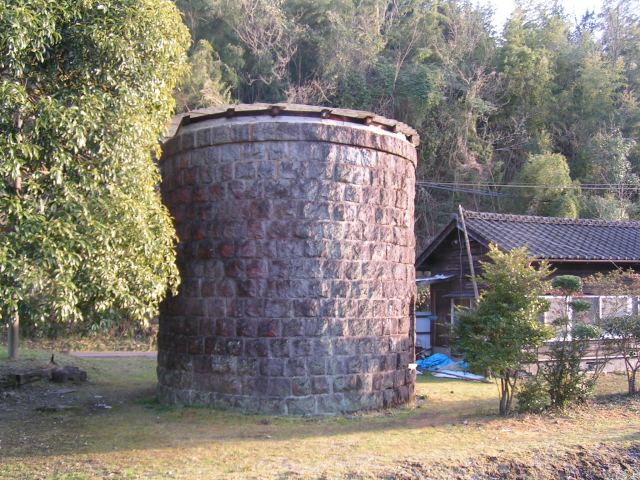
Water tower is one of the less noticeable features of the Okoba Station. It was once used for refilling the tenders of the hudge D51 locomotives that were often used in pairs in order to bring freight and passengers up the unbelievable 30 percent elevations around the station.
For years railfans have posted photos of its stone base, still intact today.

Source
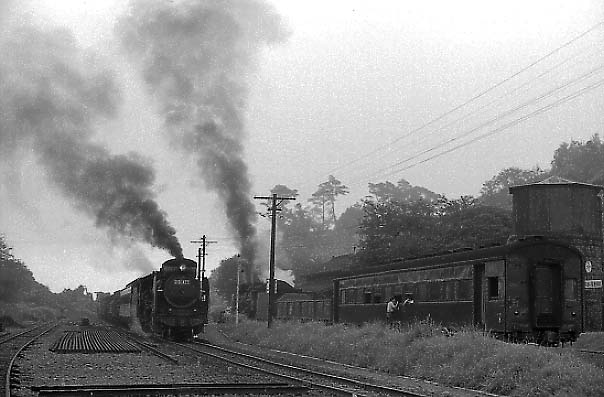
A recent search has quite unexpectedly turned up with a photo of the tower's water tank which is absent from all the other known photos available online.
Source
This photo was taken in August 1970. The other photos in the set show quite an amazing number of mixed passenger-freight consists, often headed by a pair of D51-s,  somewhat contrary to a viewpoint that freight trains were not widely operated on the line after the easier coastal route was opened.

Friday, September 24, 2010

Okoba Revisited. Now in T

It is the third year already, when autumn brings new inspiration for the construction of a Hisatsu-line inspired model railroad. During all the past months I've done quite a few things for my other project, i.e. the development of our community for those who model in HOe (1:87 on 9mm track). This has been successful, as I'm now slowly building my own module, and a much anticipated model of our very own TU2 Bo-Bo locomotive hit the shelves this summer.
A couple of days ago I've had an inspiration to find out what are the latest developments in T gauge, which we were happy to present at a local exhibition a couple of years ago (someone even posted an autotranslated newsitem on this somewhere on the net, that was fun).
48 hours later, and I'm still online, as it seems. New models, new tracks, new everything!
I was of course glad to find that both left and right switches/turnouts are finally available. Besides, Eishindo has released Kiha-40, which is just the train that still is the main player of the Hisatsu Line in real life (in different modifications, including Kiha-47 that has also been planned for release! I wish they made a 58 and a 147 as well). Combined with as little space as it takes to build a T gauge layout, it may become quite a chance.

Another couple of hours later, and a first version of layout is born. Operation is rather limited, I'll think of it more, but the footprint of only 100x50cm with large portions cut off (actually more like 50x50 + 25x50) is something I could really manage.

Wednesday, April 28, 2010

Now is the time

Now is really the time to model Hisatsu Line.

 
Microace A6072 poster image looks like a dream that finally comes true.

From the product's description:
JR Kyushu launched the Isaburo-Shinpei tourist train between the stations of Hitoyoshi and Yoshimatsu. The train departing from Hitoyoshi is called "Isaburo", the train from Yoshimatsu is named "Shinpei". KIHA-40 DMU was modified for this tourist service by special "ancient lacquer" livery, wood interior, seats in a straight back-to-back arrangement, and a special observation room with enlarged curved glass windows, which became the feature for this train.

Features
  • High quality model by Micro Ace Art No. A6072
  • Two cars, one equipped with motor and flywheel and one trailer 
  • LED Headlights,  taillights, front-lit display window type with on-off switch
  • Original "ancient laquer" livery
  • Beautiful lettering
  • Detailed interior, including special seats of the prototype
  • Two enlarged & curved side windows for panoramic view
  • An option to install interior lightning and replacement couplers 
Drawbacks
The reservation is closed. No luck this time?

Still, with this Kiha 147 from Micro Ace, the recent Kiha 58 and Kiha 25 from Tomix, one only needs a working D51 to have most of the roster used on the original line. Wonder if they would do a remake of Tomix Kiha 58 in Kyushu white with blue stripe livery - so that the picture would be complete.

Wednesday, November 25, 2009

Hisatsu Line in 1977

Early morning. A pair of mighty D51 steam locomotives pull Suhafu-type coaches to the remote Okoba station. It is 1977 again.

The site features photos of C57 and D51 steam locomotives working the Hisatsu Line between Yatsushiro and Yoshimatsu, the arrival of a Kiha 58 trainset, as well as a good coverage of mixed consists and the Okoba loop.

Tuesday, November 24, 2009

Paper models from JR West


Don't have enough fancy models by Kato, Tomix and Microace? Time for scissors, glue and a bit of fun! Whether you have a kid who is so keen about making something for his toy railroad with his/her hands, or you feel you are that kid yourself, there's a good chance there are quite a few paper models of Japanese prototype buildings and vehicles that will most probably suit your needs. The only trouble is these models are exclusively posted at Japanese websites, so once in a while take your search in one hand, Google Translate in the other - and here we go!
One of the most exciting aspects of searching (for me) is that sometimes you find something better than what you've been looking for. This time it is the website of JR West Railway Company that contains quite a number of paper models, including:

  • Simple train station of the Western region
  • Grade crossing
  • Tunnel
  • Brick two-stall engine-house
  • Platforms and overpass
  • More kids' stuff like pictures that need coloring, screensavers with painted steam locomotives 
  • A whole bunch of track elements, simple models of locomotives and multiple-unit trains (even the Shinkansens!)
And if you feel these are models just for kids (well, Iactually they are) - try your hand at the former Nijo  station (above).

The website contains no less than five sections of paper models and fun things, and there are also sub-cathegories in dropdown menus. Browse the sections - and assemble a toy-train scene, or use the structure print-outs as a base for scratchbuilding projects.

Friday, May 29, 2009

The River Line

Hisatsu Line is mostly famous for its mountain part featuring a loop, two double zig-zag stations, and a 2,5 km long tunnel on the summit of Yatake mountain. Before the line's elevations reach as much as 30%, however, more than 50 kilometers of track can be found curving along the turns of the Kuma river. Some sources refer to this section as 'the River line', however officially it is the Yatsushiro-Hitoyoshi segment of the Hisatsu Line, which is still used for local passenger traffic.
The 'River line' features numerous bridges, small tunnels and galleries, as well as a variety of rolling stock including Kiha 185-series trainsets that were some time ago offered in N scale by MicroAce. It is also notable for its picturesque surroundings, small towns along the banks of the river, and the mountains that still dominate the whole landscape.
Both parts of the line feature stations and towns that are so small that they almost look like a model train layout.
Sakamoto Station

Sakamoto station is the third station of the Hisatsu Line. The station has two tracks and a wooden station building. Stop signs for freight trains led by the mighty D51-s are still preserved. The station was opened in 1908, and became unmanned after the electonic blocking was introduced in 1986. According to data collected in 2006, the station is used by 91 passengers daily.
This station was brought to my attention by the following photo posted by goagoa on Panoramio:
View full-size image
Click the link above for the full-size image, and you will see Sakamoto station with its complete surroundings, the Kuma river and, of course, the mountains. 
Impressed by the site's completeness and character, I have taken some time to count all the houses in the area surrounding the station. It turns out there are no more than 70 buildings at all. Fore one who would desire to model a complete station of a DMU-powered railway in Southern Japan, this is a very attractive prototype. Reducing the number of houses and the required length of track by what is called the selective compression, one would be able to reproduce the same picture by a modest amount of buildings and detail.
As far as operations are concerned, there used to be some freight traffic on this section of Hisatsu Line. Besides, according to Wikipedia, about 1 km away from the station there is an industrial branch, so there may still be an occasional movement of goods - no further information for these branches is available.
All station signs on the Hisatsu Line have an image painted on the station sign. The sign for the Sakamoto station features an observatory. One would never tell from the rural look of the neighbourhood that some serious scientific research is going on, however the place seems more than convenient for this type of activity.

Monday, May 18, 2009

Kyushu Choo Choo

A fine article under a fun title "Kyushu Choo Choo" (pdf) summarizing the available information about the Hisatsu Line and the Isaburo-Shinpei retro train was written by Beth Reiber and published in the American Chamber of Commerce Japan journal in 2006. Nothing presented is new, however it is a major step forward from trying to guess the same facts from Google Translate and not being able to understand half of what is meant by the original texts.
I'm also presenting here my favourite Hisatsu Line wallpaper, published on Panoramio by goagoa. Its colors, harmony, and composition have been inspiring me for nearly half a year. 

This photo shows the feel of the remote station of Masaki, featuring another double zigzag arrangement of the Hisatsu Line. The trains appear from the right side (where the Yatake summit and the Okoba station are), come to a halt in the upper left part on a stub track hidden by the trees, then reverse to the station and continue to the lower part again hidden from view here.
Masaki area was heavily populated and had even some amount of freight operations (Station Staff, last photo), however, after a series of devastating landslides culminating in a massive landfall in 1972 when approximately 300 000 square meters of earth slid from their place and destroyed several dozens of houses, the population moved away, leaving the area deserted. The station however continues to operate. To commemorate the massive amount of work in order to restore the line after the landslide, a 8-ton boulder was left on the platform.
The Masaki station would make a tremendous small layout in N scale, however, proficiency in landscaping may be required to reproduce at least some of its remarkable features.